ONIs latest White Paper – Fast, high-throughput LNP sizing and characterization using an automated high-precision workflow read here>
Taking the scenic route: A scientist’s perspective
Author: Alisa Silco
CURIOUS MINDS
Taking the scenic route: A scientist’s perspective
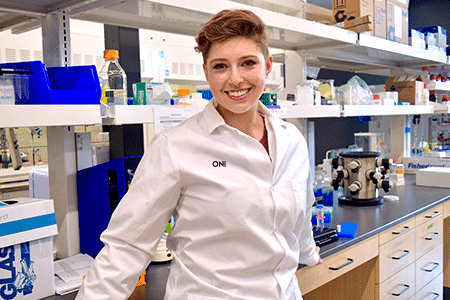
Join us on an exploration into the realm of extracellular vesicle (EV) research with Colbie Chinowsky, PhD, an Applications Development Scientist at ONI. In this interview, Colbie discusses her journey into EV studies, the key questions researchers are tackling, and the future direction of this exciting field.
How did you get to study EVs?
I first learned about EVs when I started my PhD, but didn’t think much about them at the time. I only really starting diving deep into the ongoing research on EVs when I started at ONI, and started to work on developing products for EV research.
What are the most burning questions in the field, in your opinion?
How EV contents are related to cell/organ status, and what biological events and pathways influence EV content in healthy and diseased states.
What do you find most fascinating about EVs?
EVs are a peek into how cells naturally communicate among themselves. A lot of research is done on cells or organs in isolation, but in an organism, they all have to work together to maintain homeostasis, which involves a lot of dynamic processes happening at the same time. EVs might allow us to better understand how these complicated organ systems work together to keep us alive.
If you could answer one open question in EV research, what would it be?
My PhD was focused on the intestine, which is a very dynamic organ that releases EVs and has a lot of contact with “the outside world”, which includes bacteria, viruses, food particles, etc. I think it would be really interesting to understand how the microvilli on the surface of the intestinal track interact with EVs produced from the microbiome, and how the epithelial cells of the intestine use those signals to interact with the immune system and other organ systems.
Where do you see the field is going to?
I think the field is going to become increasingly interested in the homogeneity of EV populations, and understanding how that homogeneity influences the biology.
What are the barriers in the field?
There’s a lot of nuances to doing EV work well, which could be intimidating to new researchers. The field is also relatively new (in the timescale of science), and there’s a lot of unknowns. It’s hard to know what you don’t know! Reproducibility of data is also challenging, as it is in much of biology.
What does ONI bring to the field?
ONI is taking a complicated—but powerful—technology, super-resolution microscopy, and making it an easy to use solution that is geared towards EV researchers. This will allow current EV researchers to add super-resolution imaging to the pantheon of techniques they use, but it will also enable researchers who are new to EVs to start imaging them with super-resolution with relatively little optimization time.
Where will your curiosity take you next? #CuriousMinds