Run CODI Locally With CODI Offline learn more
Getting started with DNA-PAINT: Multiplexing and quantitative imaging
Author: Anna Caballe

Discover what DNA-PAINT modality works best for you
DNA-PAINT (DNA Point Accumulation in Nanoscale Topography) enables scientists to visualize a large number of targets in a single sample and study single proteins with sub-20 nm resolutions. Its quantitative nature also enables scientists to compare different cell states, investigate molecular complexes, and even study protein stoichiometry. Here, you will learn how DNA-PAINT can work for your biological question of interest and how to get started!
DNA-PAINT: how it compares to other SMLM techniques
DNA-PAINT belongs to the family of Single Molecule Localization Microscopy (SMLM) methods, which relies on subsets of fluorophores that blink at different times (through stochastic activation) before getting rapidly switched off. After several images are acquired, single blinks are individually located using different algorithms, resulting in the highly precise localization of single molecules and super-resolution images with nanometer scale details.
Among the group of SMLM techniques, blinking of fluorophores is achieved through different means. dSTORM uses antibodies or nanobodies (single domain antibodies) conjugated to photo-switching dyes to label targets of interest using immunofluorescence. While in PALM, fluorophore blinking is induced through photoactivatable proteins that are either genetically engineered or added to cells as fusion proteins. Both dSTORM and PALM have enabled researchers to gain a plethora of biological insights, making significant progress in the understanding of biology, and achieving sub-20 nm resolutions below the diffraction limit of conventional microscopy methods. However, there are some challenges that can be associated with SMLM methods, including signal photobleaching, buffer optimization, limited simultaneous target detection, required optical setup to spectrally separate dyes, variable resolutions across targets, and target quantification constrained by blinking behavior.
DNA-PAINT can mitigate several of these SMLM challenges due to the manner in which blinking is created, by leveraging the transient binding of oligonucleotides in solution. This decouples single-molecule localization results from fluorophore photophysics. However, while DNA-PAINT generally offers higher resolution and easier multiplexing, dSTORM presents several operational and practical advantages for the users, primarily centered on speed, simplicity, and flexibility for single- or dual-target imaging. dSTORM uses standard immunofluorescence protocols and off-the-shelf antibodies, whereas DNA-PAINT requires more complex target labeling.
The target of interest is labeled with an antibody or nanobody conjugated to a single stranded DNA sequence, this is known as the docking site. Once the DNA-PAINT docking site is bound to the affinity reagent, an imaging solution is added to the sample which contains the imager strand. The imager strand is the complementary sequence to the docking strand, and it has a dye attached to it. When you start acquiring your image, imager strands diffuse around the solution very fast. While the hybridization between the imager strand and the docking strand is transient (on the scale of 100 milliseconds), blinking occurs when the DNA pair is complete, allowing for single-molecule localizations to be registered 1. An advantage of these docking strand-imager strand transient reactions is that there is an endless pool of imager strands that enable binding and unbinding throughout the entire image acquisition, providing a high photon budget, meaning a high resolution and optimal signal-to-noise ratio obtained, and the possibility of performing repeated imaging of the same field of view.
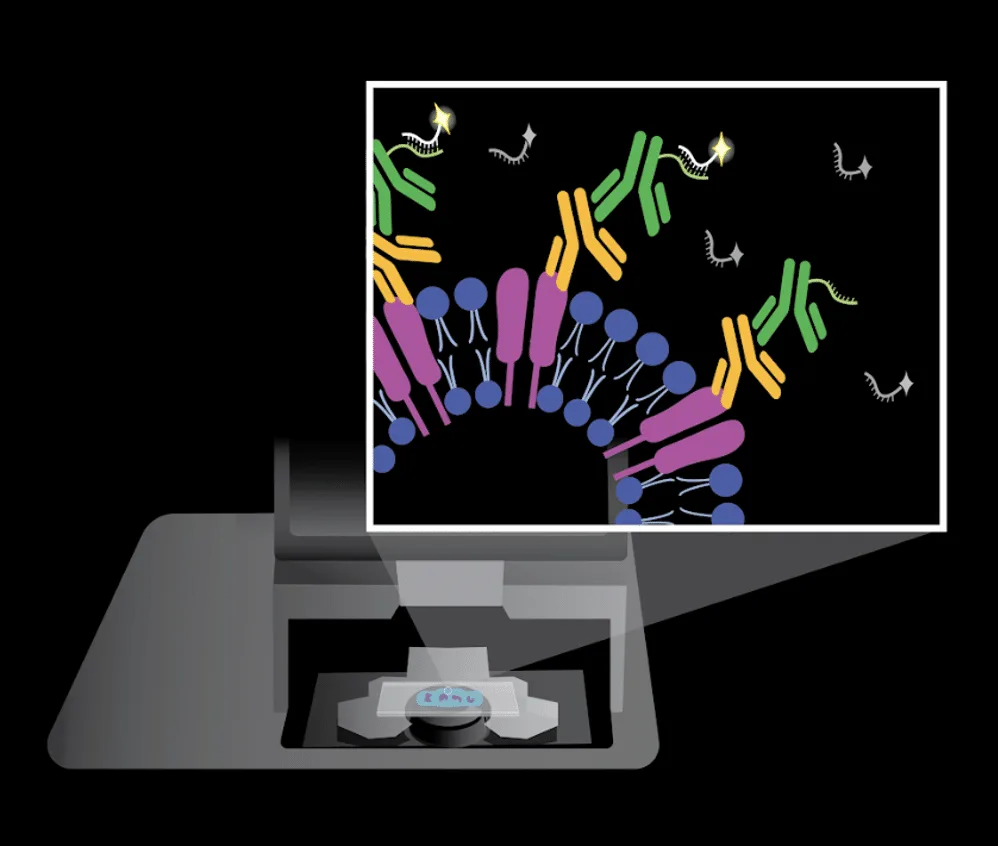

DNA-PAINT for SMLM imaging. Left: Schematic of target-bound antibody conjugated to a docking strand, with unbound and bound complementary imager strands labeled with a dye. Right: DNA-PAINT imaging of NUP96-EGFP using Cy3B dye where the characteristic nuclear pore subcomplexes 8-fold symmetry can be observed. Scale bar = 500 nm. Image acquired on the ONI Nanoimager.
Note: The combination of DNA-PAINT and dSTORM to visualize structures on the same sample is possible. An advantage to combining both methods would be to use dSTORM imaging in one channel (i.e. 488) to obtain SMLM data on a reference structure, and DNA-PAINT in the other two channels (i.e. 560 and 640) to visualize targets with maximal resolution. Imaging buffer considerations would need to be taken to ensure simultaneous performance of imager strands and dSTORM fluorophore blinking.
The value of DNA-PAINT: multiplexing and quantitative power
A key advantage of DNA-PAINT is the potential for unlimited multiplexing (with just one dye!). This is because target identity is encoded in the PAINT oligo sequences used rather than in the dye. In this case, many targets can be imaged on the same sample in a sequential manner. For instance, the target 1 is labeled with a specific antibody containing a DNA-PAINT sequence (e.g. I1). Target 2 is labeled with its specific antibody labeled with sequence I2. During imaging, target 1 SMLM acquisitions are captured first by applying an imaging solution containing the corresponding imager I1. To then remove the imager strand, the sample is washed either by hand using repeated pipetting with a wash buffer or using fluidic exchange. The lack of blinking after washing can be verified under the microscope if necessary. Next, a new imaging solution containing imager I2 is added to image target 2, then washed, and the process is continued with any remaining targets. This method is called Exchange-PAINT, and the use of commercially available kits optimized with DNA-PAINT sequences that are orthogonal to each other is recommended. For example, those offered by Massive Photonics, and compatible for imaging on ONI’s Aplo Scope and Nanoimager microscopes.
What about limitations due to antibody species? Antibody pre-incubation or pre-mixing enables the use of different DNA-PAINT sequences without having to compromise on the primary antibody species. During pre-mixing, primary antibodies are first incubated with DNA-antibody complexes, where the docking strands are conjugated to the secondary antibody. The mixture is then added to the sample to achieve species-independent immunolabeling. This is a way of using multiple primary antibodies raised in the same species to label different targets in a sample, increasing the multiplexing capabilities and spatially separating targets with no crosstalk. In practical terms, primary and conjugated secondary antibodies are mixed at certain molar ratios for around 15 minutes, instead of the usual 1-hour long separate incubations. This requires the use of secondary antibodies that have been verified for pre-incubation.

Image credit: Image acquired by Massive Photonics’ in-house team.
Example of a five-target image taken using the multiplexing MASSIVE-sdAB-FAST PLEX kit (Massive Photonics) with mitochondria TOM20 (magenta), LAMP-1 endosome (blue), Vimentin filaments (gray), caveolin (yellow), and paxillin (red) part of the focal adhesion machinery.
Another key advantage of DNA-PAINT is the ability to perform counting of target molecules, this is done in both a relative manner and as absolute counting. The method by which scientists do this is called quantitative DNA-PAINT or qPAINT and relies on the understanding of the kinetics associated with the binding and unbinding of the imager strand to the docking strand. Briefly, when looking at fluorescence intensity over time, the moment the imager strand is bound and blinking occurs is called a break time. Whereas when the imager strand is unbound, and there is no blinking, is called the dark time. Over a period of time, the frequency of binding events will depend on the number of targets detected. The number of molecules can be determined by calculating the mean dark time of the region of interest and the imager influx rate, which is dependent on the concentration of imager and its association rate 2. This information can all be derived from the DNA-PAINT SMLM data, by simply looking at the raw CSV data file.
In terms of resolution power, DNA-PAINT allows researchers to study subcellular structures at around 20 nm but also enhance resolution to achieve 1 nm spatial resolutions using a method called Resolution Enhancement by Sequential Imaging (RESI). RESI is a DNA-barcoding method that improves the resolution of fluorescence microscopy down to the Ångström scale (1Å = 0.1 nm) using off-the-shelf fluorescence microscopy hardware and reagents. This is achieved by sequentially imaging sparse target subsets at moderate spatial resolutions of >15 nm, resulting in single-protein resolution in whole intact cells 3. Sort of like performing multiplexed imaging but on a single target. RESI is particularly useful for studying oligomerization states or for single-protein resolution of highly-dense targets. This method has been recently used to elucidate the mode of action of antibody-drug conjugates in cancer immunotherapy 4.
Want to learn more about qPAINT and RESI? Watch the ONI × Massive Photonics webinar
DNA-PAINT imaging workflows
When designing your DNA-PAINT experiment, it is important to have the biological question in mind from the get-go. For instance, for mapping biomolecular distribution of proteins, single or dual color DNA-PAINT imaging can deliver sub-15 nm resolution, while RESI achieves resolution below 1 nm useful for studying protein distances or oligomeric states. For quantitative copy number information, however, qPAINT is better suited even though resolution might be slightly lower. Finally, for studying more than two targets, Exchange-PAINT uses the sequential use of imager strands to visualize up to six targets at once, ideal for probing for molecule heterogeneity of your structure of interest 5.
The first step of the entire DNA-PAINT workflow is sample preparation. The sample can either be cells, extracellular vesicles (EVs), DNA origami, or other specimens as long as they have been fixed. The labelling reagents consist of a primary and secondary antibody or nanobody conjugated to the docking strand and a complementary imager strands conjugated to fluorophores that will be added in during imaging. There are different labeling reagent options which include: a primary antibody plus a labeled secondary or nanobody, a directly labeled primary antibody, or a single-domain antibody (nanobody) against fluorescent proteins. While conventional antibody labeling offers better flexibility in experiment design, it also introduces greater linkage errors, the spatial distance caused by the physical size of the labeling bodies themselves. Reducing linkage errors enables scientists to achieve sub-10 nm resolution.
We recommend carefully selecting the DNA-PAINT imaging approach best suited to your experiment, as well as the appropriate controls. As for staining controls for DNA-PAINT, you can either use an imager strand that does not bind to the docking strand or the imager strand alone. This will help confirm that there is minimal off-target binding.
For image acquisition, a powerful super-resolution microscope is needed that is able to achieve under 20-nm resolutions. If performing multiplex imaging, as many docking strands as targets will be needed. It is important to understand the optical system and possibilities for multiplexing of your chosen system. In your first experiment, it is crucial to titrate the imager strand concentration to ensure good sampling and blinking is achieved. If the imager concentration is too high on the other hand, blinking may not be seen and background signal could be introduced. Buffer additives such as oxygen scavengers or triplet state quenchers can be added in the imaging buffer to help with photostability and yield.
In terms of laser power, this tends to be lower in DNA-PAINT than in other SLML techniques like dSTORM imaging. The sample laser exposure time will need to be adjusted according to the imager sequences selected, and the correct illumination angle selected depending on the structure of interest to be imaged and its distance to the cell surface. Unlike other SMLM techniques like dSTORM, finding focusing is slightly trickier in DNA-PAINT. This is because blinking is continuously occurring in the sample as soon as the imager strands are added. With both ONI systems, Aplo Scope and Nanoimager, live localization renderings allows you to check the sample labeling or whether the optimal focus has been achieved, and immediately tweak imager concentrations to address if needed. Finally, the imaging temperature will highly impact the imager conditions. ONI and Massive Photonics have partnered together to develop a two-plex DNA-PAINT imaging kit which provides the necessary reagents engineered specifically for the elevated temperatures (32℃) needed to achieve single-molecule imaging and sub-20 nm resolutions.
Learn more about MASSIVE-SDAB ONI 2-PLEX
If performing multiplexing using Exchange-PAINT, imaging can be done manually or automated. After labeling optimization of each individual target, manual multiplexing would allow for up to eight targets to be imaged within a day, whereby each acquisition of 20,000 frames at 100 ms exposure (of either one or two imager strands in parallel) takes 20-30 minutes. Buffer exchange can be done via manual pipetting using chambered coverslip slides, as long as the slide is firmly attached onto the stage to avoid moving the selected field of view between manual operation steps. Here, it is critical to have fiducial markers that fluoresce in all channels being used for DNA-PAINT imaging, and that do not blink or bleach.
DNA-PAINT imaging workflow automation for faster, reliable results
The main bottleneck of Exchange-PAINT and multiplexing in general is the long acquisition times that scientists face with each experiment. This can impact image quality (e.g. increased drift), particularly when using manual pipetting, as this introduces greater experimental variation and errors as well as result in long, tiring experimental sessions. This is why experiment automation through the use of microfluidic devices linked to the super-resolution microscope can be crucial to obtain reliable results in a fast and reproducible manner. With ONI’s Nanoimager the integration with microfluidics is possible through a third-party platform called Elveflow—including a flow controller, flow sensor, distribution valve, and intuitive software designed for automation and control. For Aplo Scope, active fluidic tethering of Aplo Flow to a fluidics chip on the stage will be available in an upcoming release.
Equally important is the ability to automate super-resolution imaging data analysis. ONI’s CODI cloud-based software solution seemingly integrates with ONI microscopes to guide users through key DNA-PAINT data processing steps such as drift correction, localization and background filtering, localization clustering, cluster analysis, and structure identification and sizing.
Explore DNA-PAINT for your research
DNA-PAINT enables scientists to visualize a large number of targets in a single sample and study single proteins with high resolution both within high- and low-density environments. Because of the limitless supply of imager strands, consequent continuous blinking, and the lack of time-limited imaging buffer used in DNA-PAINT, the same field of view can be imaged multiple times. This results in higher target sampling and simplified user experience. In addition, DNA-PAINT is a quantitative method, enabling the comparison of different cell states and study of protein stoichiometry. Existing DNA-PAINT solutions, such as the kits offered by Massive Photonics used together with ONI’s Aplo Scope, make it easy to get started and offer flexibility for users, including swapping the binder being used for STORM with a DNA-PAINT binder to obtain beautiful and quantitative images.
Discover how ONI can help in your DNA-PAINT journey
References
- Jungmann R et al. Single-molecule kinetics and super-resolution microscopy by fluorescence imaging of transient binding on DNA origami. Nano Lett 10(11): 4756-61 (2010). doi: 10.1021/nl103427w.
- Jungmann R et al. Quantitative super-resolution imaging with qPAINT. Nat Methods 13(5): 439-42 (2016). doi: 10.1038/nmeth.3804.
- Reinhardt et al. Ångström-resolution fluorescence microscopy. Nature 617(7962): 711-716 (2023). doi: 10.1038/s41586-023-05925-9.
- Pachmayr I et al. Resolving the structural basis of therapeutic antibody function in cancer immunotherapy with RESI. Nat Commun 16(1): 6768 (2025). doi: 10.1038/s41467-025-61893-w.
- Bond C et al. Heterogeneity of late endosome/lysosomes shown by multiplexed DNA-PAINT imaging. J Cell Biol 224 (1): e202403116. (2025) doi: 10.1083/jcb.202403116.